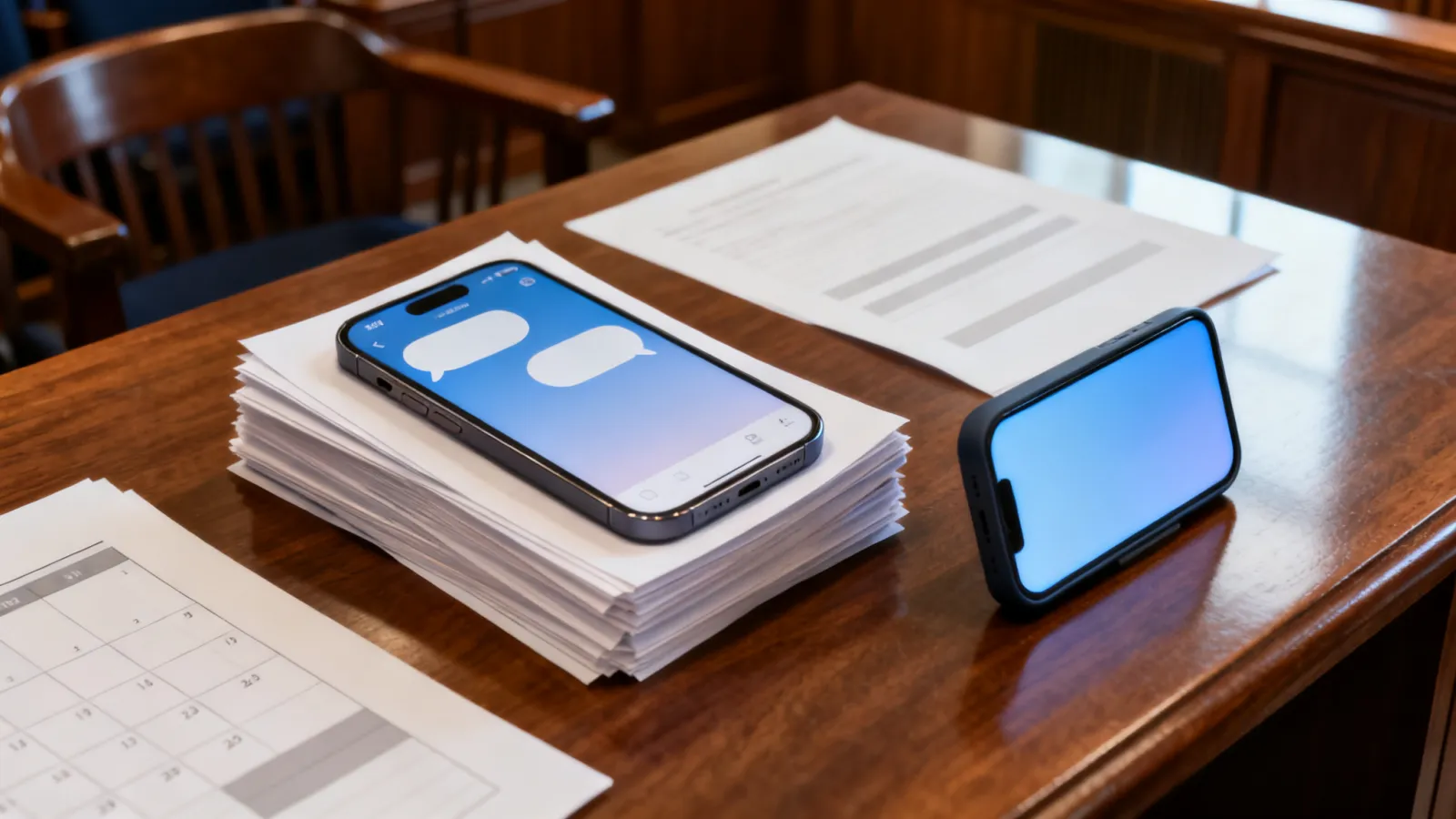
Text Messages as Evidence in Canadian Family Court: A Guide for Parents
How texts are used in Canadian family court: what the Divorce Act says about coercive control, how to save and organize messages, protection orders, and free help.

Part of our guide: Do Text Messages Hold Up in Court?
This is general information, not legal advice. Talk to a lawyer, your province's legal aid office or a family law information centre about your own situation.
Text messages can be part of the evidence in a Canadian family case, but there's no special "text message rule." A judge decides what weight to give them, and the person who brings a message to court has to be able to show it's genuine. For most parents, that means keeping the original messages, saving a complete copy, and pulling out only the parts that matter.
This guide is for parents in Canada going through separation, a parenting dispute or harassment by text. It covers the federal Divorce Act, how provinces handle electronic evidence, protection orders, and where to get free help.
Part of our guide to text messages as evidence.
The quick answer
- The court looks only at your child's best interests. The Divorce Act puts the child's physical, emotional and psychological safety first.
- Family violence includes coercive control and harassment. The Act's definition covers "a pattern of coercive and controlling behaviour" and lists harassment and stalking, psychological abuse and financial abuse. Texts often show exactly these patterns.
- The person offering a text has to show it's genuine. The Canada Evidence Act says this for electronic documents, and a screenshot or printout counts as one.
- Less is more. Ontario's Superior Court tells parties to attach only "the relevant and necessary excerpts," not whole conversations.
- Your province matters. Protection orders, legal aid and court forms differ from one province to the next.
Custody is now "parenting time" and "decision-making"
If you're reading older articles, you'll see the words custody and access. Those changed when the new Divorce Act came into force on March 1, 2021. The terms now are:
- Parenting time: the time a child spends in a parent's care.
- Decision-making responsibility: the big decisions about a child, such as health and education.
- Parenting order: the court order that sets these out.
Under section 16, the court considers only the child's best interests and gives primary consideration to the child's safety and well-being. Two of the listed factors are where text messages often come in:
- Each parent's ability and willingness to communicate and cooperate with the other. Months of messages can show who keeps the conversation about the kids, and who doesn't.
- Any family violence, including whether there's a pattern of coercive and controlling behaviour. For children, the Act counts direct or indirect exposure to that conduct.
Provinces have their own family laws too, used when parents weren't married or aren't divorcing. Ask your local legal aid office or family law information centre which law applies to you.
How courts treat texts and screenshots
Canada has federal and provincial evidence laws. The federal Canada Evidence Act applies to matters under federal jurisdiction, and provinces have their own acts for provincial matters. Alberta's, for example, has a similar rule for electronic records in section 41.3 of its Evidence Act.
In plain terms, the federal rules say:
- An electronic document includes "a display, printout or other output" of the data. So a screenshot or a PDF of your messages is an electronic document.
- Whoever offers it must show it is what they say it is. That's usually done with your own sworn evidence: who you were texting, that the number is theirs, and that you made the copy.
- The reliability of the system that stored it matters. Keeping the original messages on your phone, and a full backup, helps show nothing was changed.
A guide from the BC Society of Transition Houses, a nonprofit, suggests explaining that you took the screenshots yourself and when you printed them. How any of this is used is up to your lawyer and the court.
Exhibits: attach the excerpts, not the whole phone
In most family cases, texts reach the judge as exhibits attached to an affidavit, your sworn written statement. Ontario's Superior Court is direct about this. Its family practice direction says affidavits shall not include voluminous texts, emails or social media posts, only the relevant and necessary excerpts, and that exhibits generally shouldn't run past 10 pages.
BC's Provincial Court also asks that affidavits and documents be as short as possible. Check the rules for your court and province, and ask your lawyer what format they want.
That makes the real job finding the few messages that matter in a history of thousands, and showing each one with its date, time and sender.
Protection orders and peace bonds
Harassment by text can be part of a protection order application. Each province has its own:
| Where | Order | What it is |
|---|---|---|
| British Columbia | Family law protection order | Made in family court if you've experienced family violence. Legal Aid BC lists harassment by text message as an example. Usually applies only in BC. |
| Ontario | Restraining order | A family court order to protect your health and safety. Not following it is a crime. |
| Alberta | Emergency Protection Order | Only for family violence, when there's evidence immediate protection is needed. |
| Anywhere in Canada | Peace bond | A protection order under section 810 of the Criminal Code. Ontario notes it is not a restraining order. |
Steps to Justice, an Ontario legal information site, lists text messages, emails, voicemails and social media posts that show abuse, control or harassment as evidence you can gather. If you're in danger now, call 911.
Keep a log alongside your texts
Texts show what was written. A log shows what happened around them. An Alberta legal education guide from CPLEA suggests you keep a diary with the date, time and location of each incident and any witnesses, and organize your evidence by date, because you may need those notes to write your affidavit.
A few habits help:
- Write facts, not feelings. A Justice Canada guide for lawyers advises recording only facts, without editorializing, because notes can become evidence.
- Note the message. "March 3, 9:40 p.m.: text saying she won't bring the kids back" is easy to match to your phone.
- Don't delete anything, even messages that make you look bad. Gaps raise questions.
Recording calls
Under the Criminal Code, intercepting a private communication is an offence, but it does not apply to someone who is a party to the call or has a party's consent. That doesn't make every recording a good idea in a family case. A BC legal information wiki warns that it's not okay to secretly record your ex's calls, even with your children. Ask a lawyer before you record anyone, and never get into someone else's phone or accounts.
Free and low-cost help
- Ontario: Legal Aid Ontario, 1-800-668-8258, and free Family Law Information Centres at courthouses.
- British Columbia: Legal Aid BC, the Family Law in BC line at 1-855-875-8867, and free Family Justice Counsellors.
- Alberta: Legal Aid Alberta for parenting, guardianship, support and divorce.
- Quebec: the government's separation and support page lists a toll-free line, 1 855 537-2772.
If you're experiencing violence, the Government of Canada lists crisis lines by province, including the Assaulted Women's Helpline in Ontario (1-866-863-0511), VictimLink BC (1-800-563-0808), Alberta's Family Violence Info Line (310-1818), SOS violence conjugale in Quebec (1-800-363-9010) and Kids Help Phone (1-800-668-6868).
How TextEvidence helps
TextEvidence works the same in Canada as in the US. Bring your texts in from an iPhone backup, the free Android app (on Google Play in Canada), a screen recording or a chat export, and phone numbers in any format are matched up. Then:
- Search every message for a word, a date or a person.
- Ask questions in plain English, with answers that point to the exact messages.
- Make a dated PDF of just the conversation or excerpts your lawyer needs, with the date, time and sender on every message.
Bringing texts in and searching them is free. Full PDFs need a plan, $19 a month or $149 a year in US dollars (your bank converts it), or a one-time $29 PDF. You can also make a free PDF of your texts without an account.
Related reading: how to document harassment by text for a protective order and how to document parental alienation.
About the author
Matt C. is the founder of TextEvidence, a tool that helps parents save, search and organize their text messages for family court. This guide is general information, not legal advice, and laws differ by province. Your lawyer or the court decides how evidence is used.

Next in this guide
Text Messages as Evidence in Australian Family Court: A Guide for Parents
How texts are used in Australian family law: what the Family Law Act says about family violence, attaching texts to an affidavit, protection orders, and free help.
Keep readingReady to organize your text message evidence?
Start with the free tool, no signup required, or book a call and I'll walk through it with you.
Try the free tool
First 50 messages free, no account, no credit card. Backups are read in your browser and never uploaded.
Where are your texts?
First 50 messages free. No account. Nothing is uploaded.